The Importance of Intersectional Feminism

Intersectionality changes the way people view feminism by acknowledging differences in experiences and identities among women. Many people in today’s society fall under multiple categories based on race, sexual orientation, gender identity, nationality and disability, making it impossible to arrange each individual into a single category. This categorization dilemma especially leads to many societal problems when dealing with social and political equity. Because of these issues, intersectionality has become a crucial element in feminism. There are many examples of reasons why we need intersectionality throughout many of the Ted talks and stories we have heard in class.

The one reading I remember the most is Mapping the Margins by Kimberle Crenshaw. In this paper, she talks about a woman who was turned away from a woman’s shelter for not speaking English. In this case, they should have looked at her specific situation and tried to help instead of immediately categorizing her based on language and ability to communicate. This is a prime example of why intersectionality benefits feminism. Without it, people can end up getting denied goods and services that are freely provided to others. Restrictions and rules are not always a bad thing, but when we deny considering the differences among situations, we can end up excluding more than we include. With Intersectionality, the situation could have been that they would have looked for a translator and listened to her story to find out her needs. With a translator, they could have been able to work with her more to find an appropriate method of dealing with her specific circumstances instead of turning her away without communicating.

Another reading that made me think about intersectionality was The Treatment of Bibi Haldar by Jhumpa Lahiri.This reading made me think about how important intersectionality is when trying to find ways to help someone. This story especially made me think of this because of Bibi’s situation. Bibi fits into multiple categories because she is without her parents, she has some type of illness or disability, she lives with her cousin, and she is poor. Because she fits into multiple categories, I feel it would have been important to consider everything she had been through before they tried fixing her with cures based off of their own experiences or the experiences of the majority. One experience in particular that made me think of this was the part where the doctor tries to suggest that Bibi needed sex in order to be cured from her illness. This made me think about how categorizing can lead to jumping to conclusions. Trying to fix a specific problem without knowing the full scope of a situation can be dangerous and make a problem worse. That is why I feel Bibi could have benefited from others thinking with a more intersectional mindset.

Something I have learned in this class is that Looking at a person’s life with an intersectional lens helps you better understand their experiences in society. For example, In the novel Three Daughters of Eve by Elif Shafak. You learn about Peri’s life and her experiences in detail which helps you better understand the struggles she goes through with her faith, culture, and emotions. Peri fits into multiple categories in society because she is Muslim, female, a college student, and does not have a strong stance on her religion. During the novel, she goes through a challenging time finding a job while she is in college and with all of the background you learn about her, you understand her struggle. She also goes through the tragic events on 9/11 and has to deal with the discrimination of her culture. In the Ted Talk What its Like to be a Muslim in America by Dalia Mogahed, she talks about the events of 9-11 from her perspective. She explained how her life completely changed and how society now looked at her as a suspect for being Muslim. This shows how categorizing people based on race can create problems in many aspects of someone’s life. Without looking at her as an individual, they don’t get to see the positive aspects of her life and her culture.

Lastly, Intersectionality helps us understand equity vs. equality. Intersectionality looks at a person’s differences in experiences and recognizes that they can’t fit into one category. Through those different experiences, we are able to look into what hardships a person faces and where they are struggling. This helps us understand equity better because we can better understand who needs an advantage in order to be at an equal standing with everyone else at a societal level. Some people have disadvantages in their life, and we cannot find that out without looking at them as an individual. If we were to look at everyone in categories, we would end up giving advantages to people who do not need them. When we do this, everyone is stuck at the same place they were before when you compare them to each other. Even though it is equal to give everyone the same amount, that does not put them in an equal place at the end of the day when some have less than others.

Throughout this class, I have learned that intersectionality can play a key role in understanding a person’s experiences. Intersectionality also has a major impact in the way people are treated whether it is when looking for services or finding employment. Before this class, I did not realize how important it was to not categorize people. After learning more about intersectionality, I realize how much of an impact it has and how important it is to talk to everyone on an individual level to get to know their experiences. Learning the benefits of intersectionality and the harmful effects has also taught me to be more aware of categorization in my own life and lead me to adapting a more intersectional mindset. Overall, I think Intersectionality can make a positive impact in society and continues to be an important aspect of feminism.

Is Miss Universe Empowering?

https://www.byrdie.com/miss-universe-feminism

This article is about the Miss Universe Pageant and how it can be empowering for the women who compete in it. Something that surprised me was that the interview portion makes up 60% of the Miss Universe pageant. This is important because it shows how they are valuing intelligence as well as beauty. Something else that surprised me was that some countries highly value pageants and even treat the contestants like Olympic athletes. This made me think about the film we watched in class about the Miss India pageant. A country can be split or can be fully supportive, it just depends on the culture and the beliefs of people. While some people see it as a degrading competition, others may see it as a helpful platform that allows women to speak about charitable causes they care about.

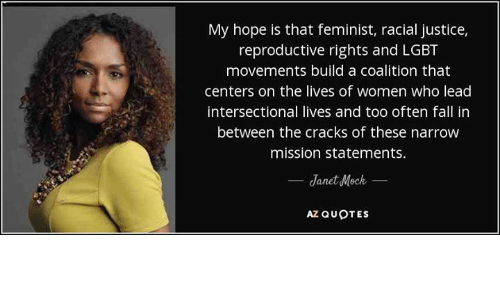
Intersectionality

This quote is by Janet Mock, a transgender activist. This quote reminded me of the reading we did in class by kimberle Crenshaw called Mapping the Margins. The part in this quote that reminds me the most of that reading is the piece at the end that says people too often fall between the cracks of narrow statements. This reminded me of the part in the reading about women not being able to go to women shelters because of a language barrier or lack of federal documentation. It made me think about how placing requirements on services ends up categorizing people. This categorization can lead to shutting out many people who are in need of these services just because they live an intersectional life.

Practicing Pilgrimage Lecture Response

I attended the Practicing Pilgrimage lecture by Dr.Stephanie Paulsell. During the lecture, Dr. Paulsell shared her experience going on the St. Cuthbert’s Way Pilgrimage as well as a pilgrimage following Virginia Woolf’s novel To the Lighthouse. She explained the many struggles and realizations she had on the journey and applied the experience of going on a pilgrimage to navigating politics in today’s society. Dr. Paulsell also included different perspectives of pilgrimage in her lecture by sharing the experiences of others and the impact pilgrimage had on their life.

A part that stuck out to me was when she mentioned a comment her sister made on St. Cuthbert’s Way. When the two were lost, they had to pull out a map and written descriptions to find their way back to the trail. This prompted her sister to make a connection between finding their way back to the trail and having to pull out every resource available in order to not be lost in today’s political landscape. I thought this was interesting because it made me think about how many different choices there are in politics and how it might be overwhelming to choose a side when a person fits into more than one category. The response made me think about the topic of intersectionality and how many people can be apart of multiple categories concerning race, gender, sexual orientation, ect. this made me wonder why choices in society and politics are not more flexible and inclusive to people who fall under multiple categories.

Another moment that stood out to me from the lecture was Dr. Paulsell’s reflection on her pilgrimage following Virginia Woolf’s novel To the Lighthouse. During the journey, her group shared personal stories with each other and their reasons for going on the pilgrimage. Their reasons, emotions, and experiences differed, but by the end of the trip they all had gained new perspectives on life that broadened their thought process and decision making. I made a connection to this experience with the topic of ethnocentrism and the importance of seeing difference. By gaining new perspectives through the sharing of stories, emotions, and experiences, I believe that it helps people see the importance of difference. I believe opening up to different cultures, ideas, and beliefs, can help decrease ethnocentric thoughts because it’s widening a person’s perception of the world beyond their own country.

I was surprised to have found this lecture relatable to concepts concerning feminism. Before the lecture, I could not think of connections between the two. Overall, the lecture taught me a lot about broadening my own perspective and slowing down to reflect on life. Most importantly, I believe this lecture showed me the importance of being open to new experiences in order to learn more about other cultures. By attending this lecture, I learned more about what a pilgrimage is and what it means to different people. By focusing on individual experiences in the lecture, I was able to see that people can perceive identical situations differently and that generalizing an experience would cut out the possibility of having a broadened perspective on different societies and cultures.

Feminism in Graphic Design

Can a Design Process Rooted in Gender Theory Truly Work in Practice?

Feministika is a design studio that uses “norm creative strategies” in the graphic design process. These strategies involve thinking critically about discriminatory values and standards within graphic design. I believe this is an important example of feminism because it shows you can challenge social constructs and ingrained ways of thinking by questioning design decisions. When you look at decisions with a more critical eye and dissect the meaning behind them, It might reveal that it’s not as inclusive as it was originally thought to be.

Cheryl Eisen

I chose this quote because it shows how stereotypes affect women in the field of interior design. People often think interior design is just interior decorating and some of that comes from the stereotype that women are more delicate and detail oriented. Since there is a lot of women in the field of interior design, some people assume the job of interior designer only deals with delicate and intricate things like furnishings and finishes. Because of this, people do not realize Interior Design also includes an understanding of architecture, electrical, and plumbing which could be considered larger business affairs.

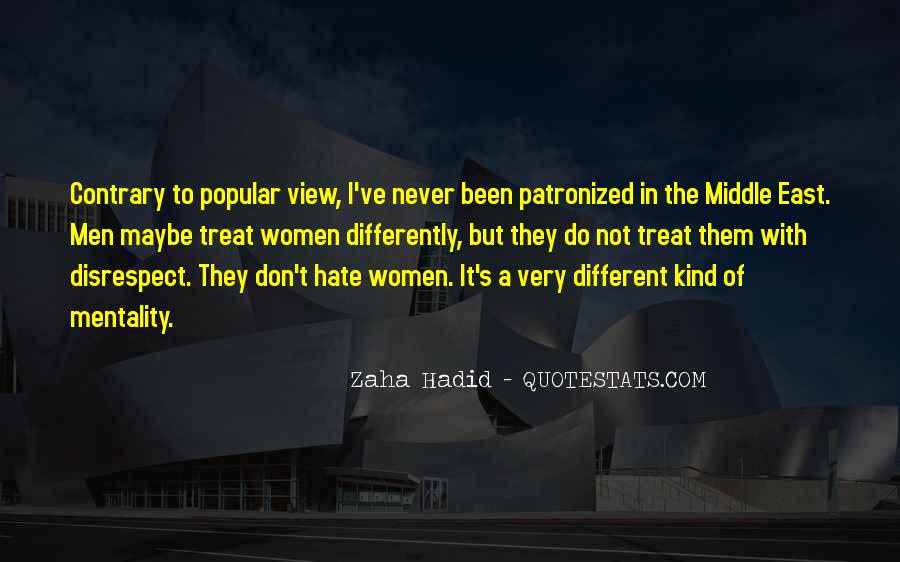
Zaha Hadid

Zaha Hadid was an Iraqi-British Architect who passed away in 2016. She won many awards such as the Pritzker Architecture Prize in 2004 and the Stirling Prize in 2010 and 2011. This quote reminded me of the topic of Ideology we discussed in class. Zaha Hadid is bringing attention to the ideology some people have that all men disrespect women in the Middle East. Women in the Middle East might not find something as disrespectful even though other cultures might define it as disrespect.

Design a site like this with WordPress.com
Get started